
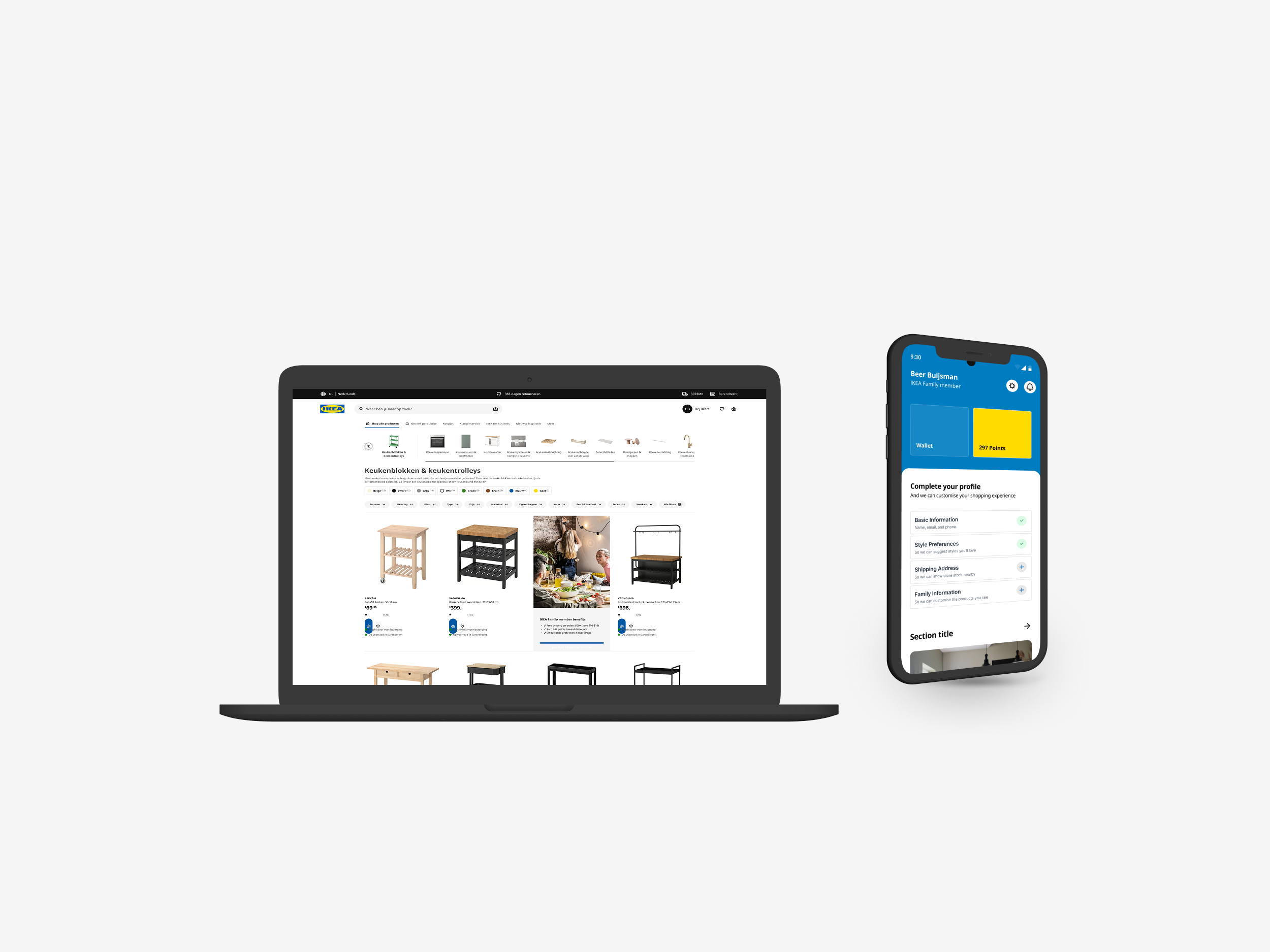
IKEA Family has millions of members across Europe, but the data powering it was fragmented, the signup flow was leaking conversion, and the loyalty proposition needed a credible reason to stay. I was brought in to make sense of it: what data existed, what it could do for members, and how to close the gap between joining and staying.
The brief
IKEA's digital team needed a coherent customer data strategy for IKEA Family, one that connected loyalty, personalisation, and signup into a single, defensible direction. The work spanned three connected tracks: understanding what data IKEA held and what it was worth, redesigning how that data was collected from members, and rethinking the loyalty proposition itself.
My role
Lead service designer, working directly with the IKEA digital product team. I owned research, framework development, journey design, and a 71-slide handover deck covering the full scope of work.
The work
Making the data legible
The first problem was structural. Customer data sat across eight separate stores, purchase history, household profile, consent records, in-store interactions, with different owners, schemas, and freshness. Before any personalisation strategy could be credible, someone had to map what existed and what it was actually worth.
I built an audit and taxonomy covering all eight data sources, classifying each field by type, retention rule, and business value. This became the foundation for everything that followed.
The Fair Exchange Principle
Collecting more data from members only makes sense if members get something tangible back. I developed the Fair Exchange Principle as the strategic frame for this: a structured way to evaluate every data field against the value it unlocked for the member, rather than the value it extracted for IKEA.
This principle governed the dynamic signup form work, the field-by-field rationale documentation, and the gamification concepts, making it a connective thread across all three tracks rather than a standalone deliverable.
Redesigning signup
The existing IKEA Family signup captured a fixed set of fields regardless of context. I researched and designed a dynamic alternative: a form that adapts based on signals like browsing context, device type, and geographic region, showing only the fields that are relevant and earnable at that moment.
Research covered progressive profiling case studies, GDPR implications for field variation by EU region, and the evidence base on form length versus conversion. The output was a signal matrix, a field-by-field rationale document, and annotated wireframes ready for handover.
Guest-to-member conversion journey
A significant share of IKEA's transactional traffic moves through guest checkout without any loyalty touchpoint. I mapped the full guest-to-member conversion journey across digital and physical touchpoints, identifying the moments where membership becomes relevant and valuable, and the moments where a heavy-handed pitch kills trust.
The journey map covered six stages, annotated with conversion opportunities, friction points, and copy principles for each.
Gamification concepts
To give members reasons to engage beyond the transaction, I developed a set of gamification concepts for web. The final five — home profile completion, verified buyer badges, points preview in cart, photo reviews, and in-store receipt scanning, were selected through stakeholder workshops and scored against the Fair Exchange Principle. Each concept was wireframed and documented with rationale.
In-store email bounce reduction
A practical operational problem: email addresses captured in physical stores were bouncing at high rates, reducing the effective size of the loyalty database. I mapped the in-store signup journey, identified the points of failure, and designed a revised flow that reduced ambiguity in how staff collected and entered email addresses.
Handover
The engagement closed with a 71-slide handover deck covering all tracks: the Fair Exchange Principle in full, the data audit and taxonomy, the signup redesign, gamification concepts, the conversion journey, and a loyalty programme audit mapped against established engagement pillars. The deck was built to be picked up and acted on by a new team without loss of context.
What I learned
IKEA Family's strongest asset is the physical store relationship, millions of interactions that generate no digital data trail. The most interesting design problems were about bridging that gap: making in-store moments legible to digital systems, and making digital membership feel worth the effort to someone who already has a loyalty card in their wallet.