
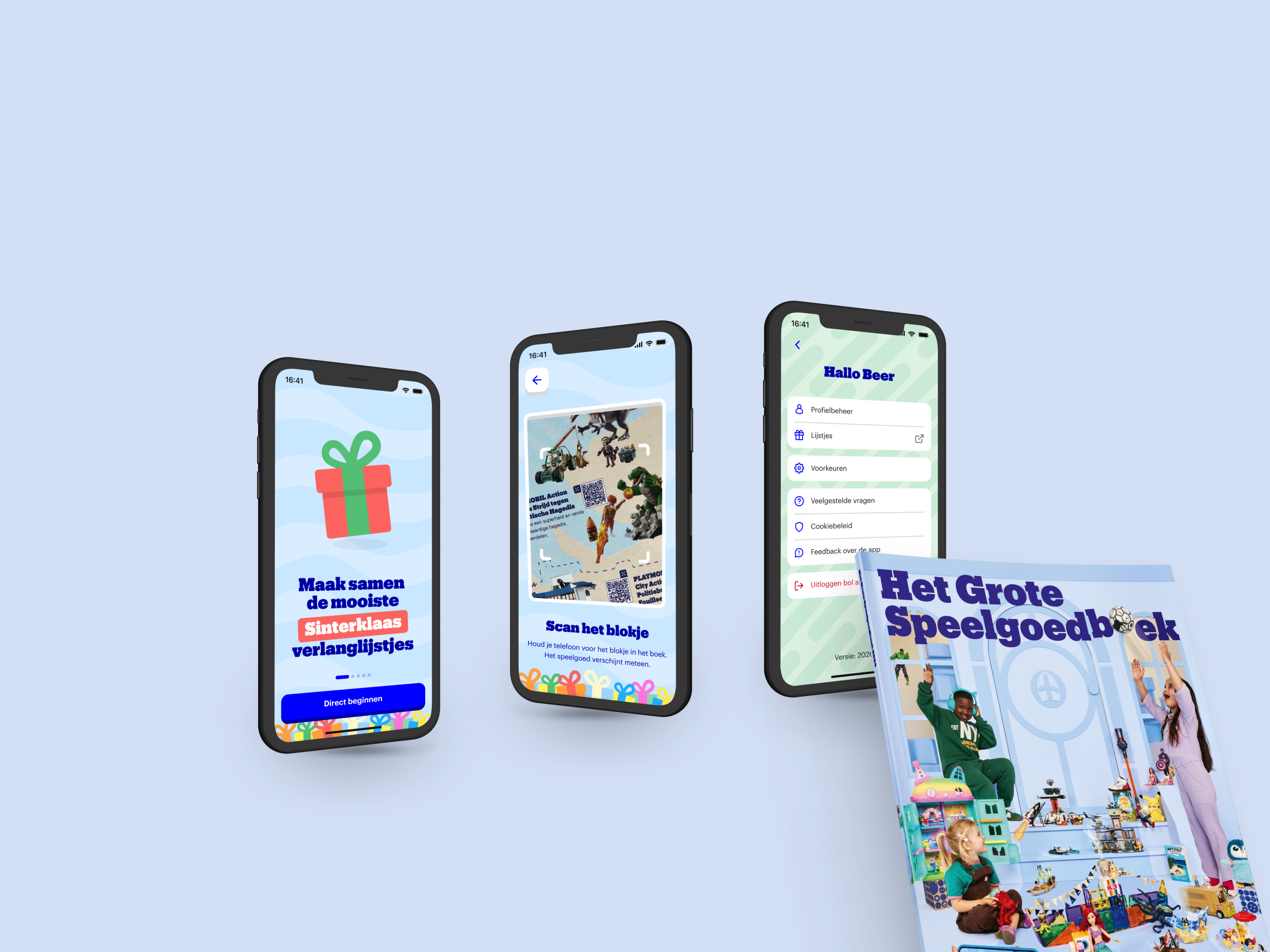
Bol.com's toy catalogue app had a seasonal usage problem, a trust problem, and an onboarding problem. I led the research and concepting work to understand why parents weren't staying, and what a year-round product could actually look like.
The brief
The Grote Speelgoed App (GSA) is bol.com's seasonal toy catalogue, built around Sinterklaas, used intensively in the run-up, then largely abandoned. The team needed to understand whether year-round value was possible, and if so, what that product would need to do differently. My brief was to lead concepting and research: talking to parents, mapping the full service, and finding the strategic direction that could justify the next phase of development.
My role
Lead concept designer, embedded in Team Toys App at bol.com. I owned the research programme, synthesis, service blueprinting, design implications, and stakeholder communication across a five-month engagement.
The work
Understanding why parents weren't staying
Before exploring solutions, I needed to understand the problem clearly. I ran eleven qualitative parent interviews over two days, covering screen time philosophy, how families managed device access for children, how they used the app, and what would make them open it in July.
The interviews produced findings that reframed the project. The problem was not the app's feature set, it was trust. Three numbers defined the landscape:
- 84% of parents dropped off during the onboarding video
- 54% had never connected a bol account to the app
- Near-total usage dropped off after Sinterklaas, every year
Accidental purchase fear, the worry that a child could buy something without a parent realising, came up in virtually every session. It was the most consistent barrier, and it had nothing to do with login friction.
Reframing the problem
Halfway through the research phase, a stakeholder request came in: add a guest mode to reduce login drop-off. I pushed back.
Guest mode addresses friction at the account-connection step, but the data showed that the real drop-off happened before that, during onboarding, and that the parents who connected accounts still left after Sinterklaas. The problem was trust and perceived value, not login mechanics. I documented this reframe with supporting interview evidence and proposed lower-scope alternatives: better onboarding messaging, a short explainer flow, and a limited wishlist preview.
The living research document
Synthesis across eleven interviews produced a structured research document with the following components:
- Top insights ranked by frequency and strategic relevance
- Full findings with supporting quotes
- Per-participant profiles covering household structure, screen time philosophy, and app relationship
- Design implications organised as must-have, should-have, could-have, and longer-term
- A screen-time philosophy spectrum mapping where participants sat between permissive and restrictive approaches
The document was built to stay live, updated after each session rather than produced at the end, so the team could act on findings in real time.
Service blueprinting
To map the full picture of how the app sat within the broader bol.com ecosystem and parental context, I built a service blueprint covering the end-to-end parent and child journey. The blueprint ran to 83 rows across 35 sub-steps, formatted for TheyDo import.
It covered frontstage interactions, backstage processes, and system dependencies, from the moment a parent first hears about the app through to post-Sinterklaas retention (or churn).
Quantitative research planning
To validate the qualitative findings at scale, I developed a quantitative research brief for an external agency. The brief translated the interview themes into measurable questions: How widespread was accidental purchase fear? What percentage of parents would consider using the app outside the gift-buying season? What features would change that?
The brief went through two rounds of tightening, the first version was too long to yield clean data, and the final version covered the priority questions in a form the agency could field directly.
Beta parent group
To build an ongoing feedback channel, I designed a recruitment and engagement plan for a beta group of 24 internal bol.com parent-colleagues. The plan covered screening criteria, communication approach, session cadence, and what the group would be asked to do, structured to give the team a reliable research pool without creating participant fatigue.
Stakeholder communication
The engagement involved navigating internal friction at several points: pushback from the UX research team over internal participant recruitment, a scope-creep request from a product owner, and the guest-mode disagreement noted above. I documented my rationale on each, communicated directly with the stakeholders involved, and kept the work moving.
A presentation for the broader design team covered the research phase from brief through to synthesis, with findings and design implications structured for a mixed audience.
What I learned
The seasonal toy catalogue is a genuinely difficult product to extend year-round, because its core value, helping parents pick gifts, is structurally seasonal. Year-round value requires either redefining what the app is for, or finding the moments outside gift-buying season where parents still need help with toys and play. The research pointed toward content discovery and play inspiration as the most plausible directions, but they require a different proposition than the current app makes.
The interview finding I keep coming back to: parents don't distrust bol.com. They distrust giving their child an unsupervised device. The app's job is to make parents feel in control, not to minimise friction for children.